| Fake Belgiums Exports of Belgian beer are doing well. But despite that there is a new trend which is causing concern among representatives of the Belgian beer Brewers Association. "Apparently, we're victims of our own success," said association president Philippe Buisseret. "Every country offering Belgian beer, whether it's Great Britain, Italy, France or the United States, tries to imitate our manner of brewing. Local beer producers see that the typical Belgian beers are selling well and try to make their profit from that." He went on to say that some pubs abroad are offering beers with the label "Belgian beer", without there being any connection with Belgium whatsoever. "An even bigger problem is that many beer makers are offering their beer with the label "Belgian style" without there being any Belgian connection." Belgian MP Sven Gatz (Flemish liberal) has launched a campaign to tackle the problem. He has also written to other Belgian MP's to make them aware of the problem. As for now he's recommending that beer drinkers around the world look for "Made in Belgium" on the label and to stay away from anything that uses the word "style". |
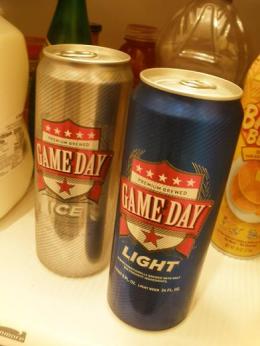
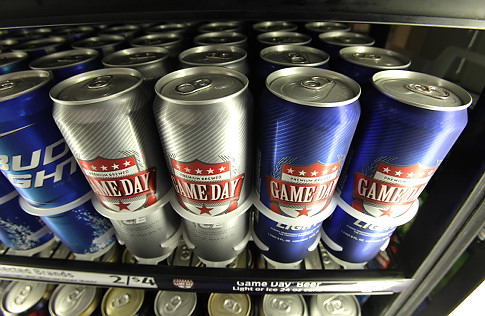
| 7-Eleven Beer The battle over shelf space in the beer industry is about to heat up with the entrance of a new brand to the refrigerators at 7-Eleven. And it's the nearly 6,000-strong convenience store chain that is making the private label brew, called "Game Day". As the third-largest beer retailer in the U.S 7-Eleven hopes to hit a sales bonanza with its new brew. Game Day comes in two varieties. Game Day Light is 3.9 percent alcohol by volume and 110 calories per 12 ounces. Game Day Ice is 5.5 percent alcohol and 155 calories. 7-Eleven might not know a lot about brewing -- it's reportedly leaving that to City Brewing in LaCrosse, Wisconsin -- but it does know beer, given that a huge chunk of industry sales in the USA take place at convenience stores. Convenience store beer buys dropped 4% in 2009, a steeper decline than seen in other outlets. But sales of below-premium beers have held up and have even seen a slight lift. Average price for a Game Day beer 12 pack is $8.99 while a 24 oz. can will sell for $1.79 7-Eleven has a history of dabbling in this arena. Remember Santiago? (You probably don't.) The chain launched the brew in 2003 to get a piece of the imported beer craze, but like a lot of private beer labels struggled to get a foothold in the market. Game Day beer follows the introduction of the Yosemite Road private-label wines in 7-Elevens last year. The idea of the home of Slim Jims and Slurpees turning sommelier had some scoffing. But Skinner said the launch has gone well, with the wines holding the No. 1 and No. 2 spots in the chain's wine sales. Whether people are ready for 7-Eleven beer remains to be seen. |

Feature News from beernexus.com
| Drink, Don't Study Students who take exams the morning after a night of heavy drinking do not end up with lower marks, according to a new study. A team of researchers, from Boston University School of Public Health and Brown University, tested 193 university students, aged 21 to 24. Over the course of four days one evening and the next morning, and then a second evening and morning a week later volunteer participants received either beer or nonalcoholic beer. They received the opposite drink the second time they were tested. The morning after, participants were given the practice versions of a university exam, as well as a mock quiz on an academic lecture they received the previous afternoon. Students were monitored overnight by a medical technician. The study found that participants scored no differently on the test, or on the quizzes, whether they had consumed alcoholic or non-alcoholic beer. However the study noted that binge drinking could affect other types of academic performance, such as essay-writing and problem-solving requiring higher-order cognitive skills. Congrats Jim Twenty-five years ago this month, a consultant turned entrepreneur began selling a new beer to Boston bars out of a station wagon. Jim Koch hoped he could build a modest local business with a high-priced brew that was heavier on hops and malt than most domestic beers. Today his Boston Beer Co., the maker of Samuel Adams Boston Lager, is now a publicly traded company with a market capitalization of about $790 million. Congratulations and thanks to Mr. Koch, chairman of Boston Beer Co., for helping foster a revolution in small-batch American brewing. |
 |
| |
 |
Edited by Jim Attacap